2026 · Brand identity · Print · Apparel
Cal Hacks 13.0
A travel-themed identity for the world's largest collegiate hackathon
- Role
- Design Director, Hackathons @ Berkeley
- Team
- TODO — e.g. 4 designers
- Timeline
- TODO — e.g. 10 weeks
- Event
- Oct 23–25, 2026 · Palace of Fine Arts, SF
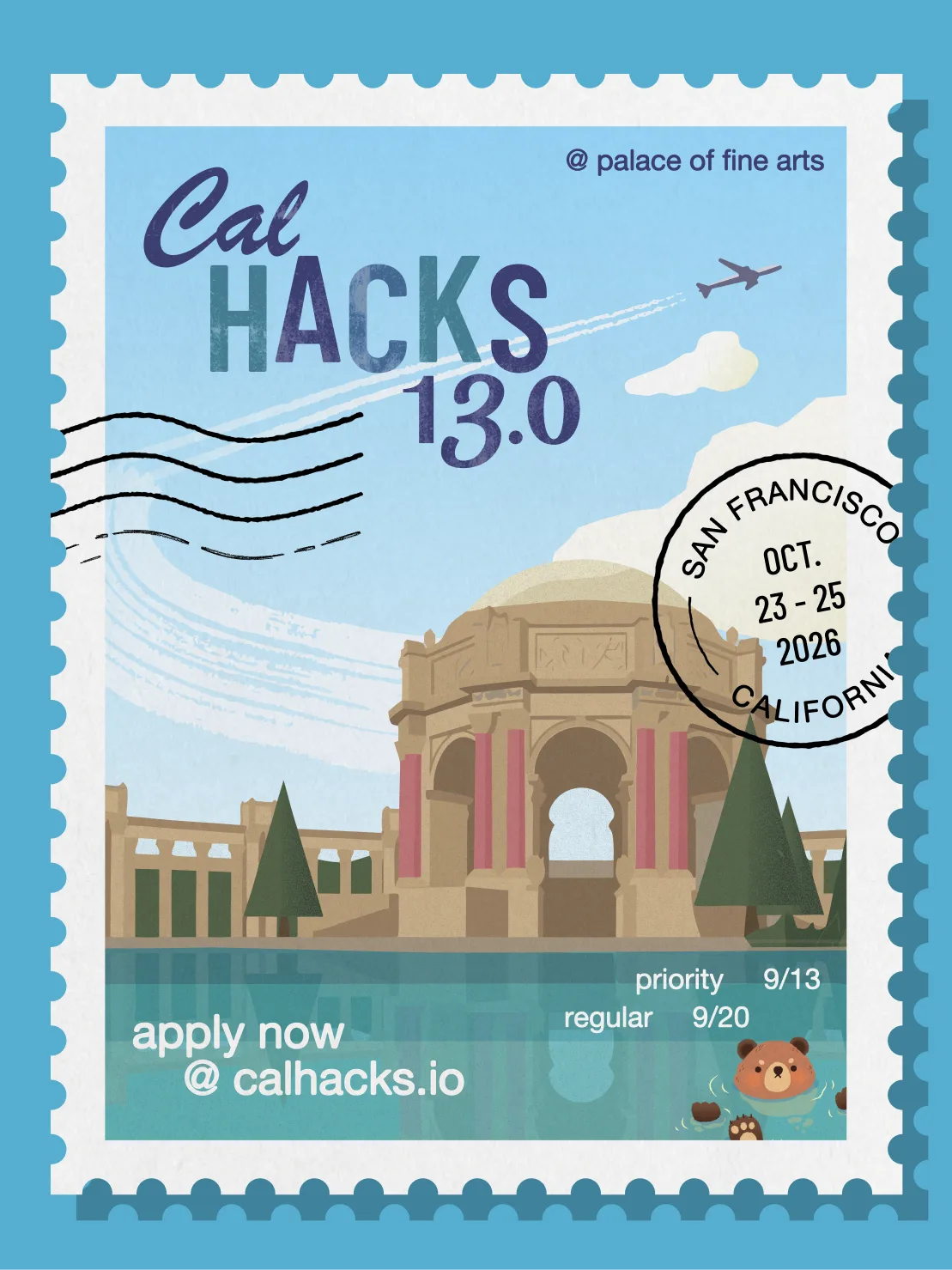
Cal Hacks 13.0 moved to the Palace of Fine Arts in San Francisco — the first time the event left campus for a landmark venue. The identity had to earn that stage: recognizable from across a hall, warm enough to make a first-time hacker feel invited, and flexible enough to survive being printed on everything from a stamp-sized sticker to a sponsor wall.
The idea: a trip, not a competition
Hackathon branding defaults to circuitry, terminals, and neon. That language sorts people before they arrive — it reads as a place for students who already identify as hackers.
So the concept went the other way: a weekend in San Francisco framed as travel. Postage stamps, luggage tags, film strips, and customs cachets. The venue became the postcard image, and Ddoski — the Cal Hacks bear — became the traveler.
TODO — add the real origin of this direction. Was it a brief, a team workshop, a rejected first round? Recruiters care more about why this direction beat the others than about the direction itself.
Building the system
The palette holds a deep navy against a washed sky blue, with sand and coral as warm relief — close enough to vintage travel print to feel referential, saturated enough to survive a phone screen.
Every artifact borrows one piece of postal grammar rather than all of it. The announcement poster is a stamp, perforations and cancellation marks included. The event series poster is a hard-shell suitcase covered in destination decals. The t-shirt is a strip of exposed film.
TODO — note the type choices here and why. The script on the stamp versus the geometric sans on the tee is a deliberate contrast worth a sentence.
Designing for production, not just for Figma
The film-strip tee was drawn as a one-color screen print, which forced the photographic frames into high-contrast halftone. The printer flagged that distress detail under 1.25 pt might drop out — so the artwork was rebuilt with a coarser grain that survives the screen.
The same lockup had to work as navy ink on white and as white ink on navy. Reversing a halftone is not symmetric: ink spreads, so the fine white specks in the negative version close up and the frames go muddy. The two colorways are separate files with separately tuned grain, not one file with the colors swapped.
The press also centers artwork on the midpoint between its leftmost and rightmost marks, which is not where this design looks centered — the paper plane breaks the right edge. The placement was specified by hand against the collar instead of letting the default do it.
TODO — if there were other printer rounds worth describing, this is the section recruiters read closest. Specific constraint, specific change.
The sponsor problem
Thirty-plus sponsor logos have to share one t-shirt back without turning into soup. They arrive in different formats, weights, and aspect ratios, and every one of them is contractually entitled to a certain size.
The solution was a tier-based grid: logos scaled by sponsorship level, optically balanced rather than mathematically sized, and all flattened to a single ink so no brand's color could dominate another's.
The same system generated a set of collectible sponsor trading cards — which gave every sponsor a dedicated piece of art instead of a slot in a grid, and gave hackers a reason to visit every booth.
Ddoski Around the World
The trading cards turn the travel idea into a collection. Every card shares the back shown above: a globe with a plane in its wake, the line 'Go outside your comfort zone. Explore. Network. Have fun.', and a promise of more than thirty cards to find. The back is the pitch for walking the sponsor floor.
The front is where Ddoski travels. Each sponsor gets its own trip: snorkeling through a school of fish for Microsoft, snowboarding in a scarf for Atlassian, on safari with a pith helmet and a paper map for Adobe, roping a lasso from the back of a cow for Anthropic.
As on the AI Hackathon cards, the frame is the constant and the metal is the variable. Every card has the same comic-panel scene, the sponsor's name in braces, and their mark in a round seal. Bronze, silver and gold run up the tiers to the Golden Bear level, and anchor sponsors get a holographic rainbow foil.
Tourist Traps: the travel idea as an object
The concept earns the most when it stops being printed and starts being handled. Tourist Traps is a blind box — a kraft shipping carton addressed to Cal Hacks 13.0 at 3601 Lyon Street, postmarked for the weekend of the event, sealed with a strip of washi tape and stamped with Ddoski.
Inside is a set of polaroids of places people actually go: the Golden Gate Bridge, Lombard Street, the Painted Ladies, Chinatown, Pier 39, Alcatraz. Each one is hand-painted rather than vectorized, taped at the corner, captioned in handwriting, and tagged with a Ddoski sticker — a souvenir photo, not a logo placement.
The box is drawn as a real dieline, with flaps, glue tabs and a printed contents panel on one side listing the odds — three of the six at 1/5, three at 1/8. That panel is the part that makes it a blind box rather than a gift box: you know what the set is and you do not know what you got, which is the whole reason anyone trades.
TODO — confirm the production details before this ships: quantity, stock, who printed and assembled it, and whether the 1/40 on the front panel means forty boxes or forty variants.
Where it stands
Cal Hacks 13.0 runs October 23–25, 2026, so this one is not a retrospective — the identity is in market now. Applications closed in September on the two deadlines printed on the stamp poster, the Hack Month nights ran through October, and the apparel and blind boxes are in production for the weekend itself.
TODO — after the event, replace this section with what actually happened. Applications received against prior years, attendance, how much merch moved, sponsor renewals, anything measured. If nothing was measured, say what you observed and what you would instrument next time. An honest 'we did not track this, here is what I would track' reads better than silence.
The full set of Cal Hacks 13.0 artifacts.
Next project