2026 · Brand identity · Illustration · Print
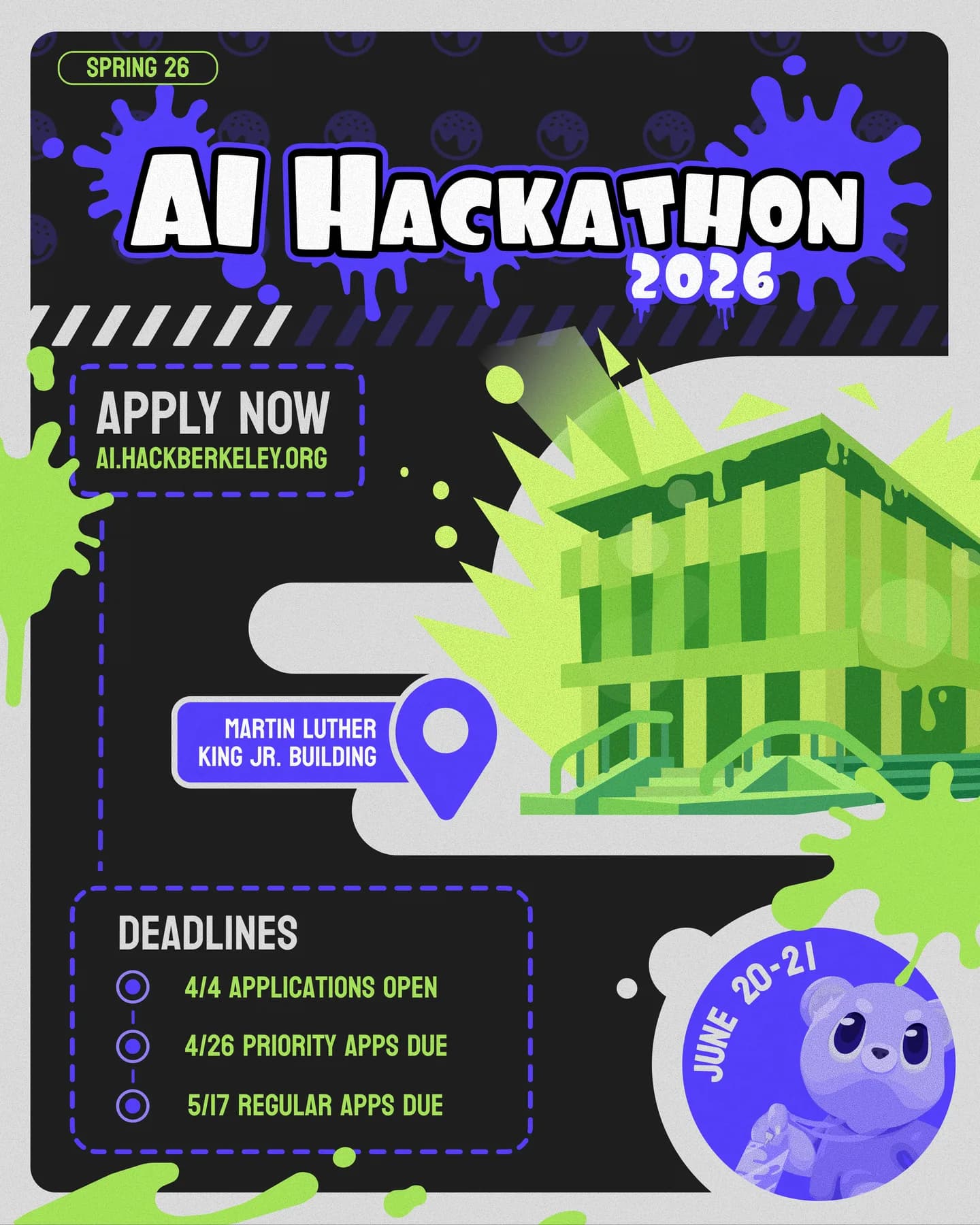
AI Hackathon 2026
A paint-splatter identity for Hackathons @ Berkeley
- Role
- Design Director, Hackathons @ Berkeley
- Team
- TODO
- Timeline
- TODO
- Event
- June 20–21, 2026 · MLK Building, Berkeley
Where Cal Hacks 13.0 was a postcard, AI Hackathon 2026 is a wall someone just tagged. The event needed an identity loud enough to cut through end-of-semester noise, and a system organized enough that a four-person team could ship posters, guides, apparel, and social assets in parallel.
Loud on purpose
The brief was attention. Spring semester is saturated with club recruiting, and an AI hackathon in June competes with internships and summer plans.
The answer was paint: splatters that break the frame, drip-shadowed display lettering, hazard striping, and a halftone-dotted ground. Electric violet against acid lime — a pairing that is nearly unusable in small doses and perfect at poster scale.
TODO — what else was explored before landing here, and why this won.
One template, four colorways
Every person at the event gets a guide, and each audience needs a different one. Hacker, mentor, judge and volunteer share a single composition: a bordered travel-poster frame, a flat-illustrated Campanile under a low sun, and splattered display type.
Only the palette changes. Violet on lime for hackers, blue on peach for mentors, pink on mint for judges, green on lilac for volunteers. The grain overlay across all of them does the work of making flat vector shapes feel printed.
This is the part of the system that scaled: new audience, pick a colorway, keep the composition. One person can produce a fourth guide in an afternoon without a review cycle, because there is nothing left to decide.
TODO — confirm whether this was built as a Figma component set or with variables, and say so. Interviewers ask.
The same joke, four times
Each guide's back cover is the same gag in its own colorway — a laptop showing 'happy hacking :)' in a pixel font, floating against tricolor bands.
Pulled off the guides and printed as a set, they read as a collection rather than a repetition, and they gave the team cheap, fast wall coverage for the venue.
Sponsor cards, by tier
Sponsors buy tiers, and a tier has to be visible without being tacky. Rather than printing a logo bigger, each tier gets its own card: a painted scene behind a die-cut frame, with the sponsor's name in the top plate, their mark in the bottom corner, and the tier called out on the banner.
The frame is the constant — same plate, same corner badges, same checkered flag. The metal is the variable. Bronze for SkyDeck, brushed silver for QNX, gold for Midjourney's Golden Bear tier, and a holographic rainbow foil for fetch.ai at the top.
The artwork is deliberately unlike the posters. Where the event identity is flat vector and acid-bright, the cards are soft painted gouache — Sather Gate at midday, the Campanile against a night Golden Gate, a picnic blanket, a desk at sunset. They are meant to feel like something you keep rather than something you were handed.
TODO — the fetch.ai card is the only one of the set still coming from a low-resolution export (372px wide). Re-export it at the size of the other three and re-run the image script.
Off the page
The identity also runs to a navy zip hoodie — rocket, astronaut and a 'made with ♥' lockup on the back, a small chest mark on the front — and to vertical story graphics sized for Instagram.
TODO — the hoodie source file is low-resolution (554px wide). Re-export at print scale and re-run the image script so it holds up next to the posters.
What it did
TODO — the event ran June 20–21, 2026, so the numbers exist somewhere: applications against the 4/26 priority and 5/17 regular deadlines, attendance, social reach on the countdown posts. Same note as the Cal Hacks case study — numbers if you have them, honest observations if you don't.
Next project